
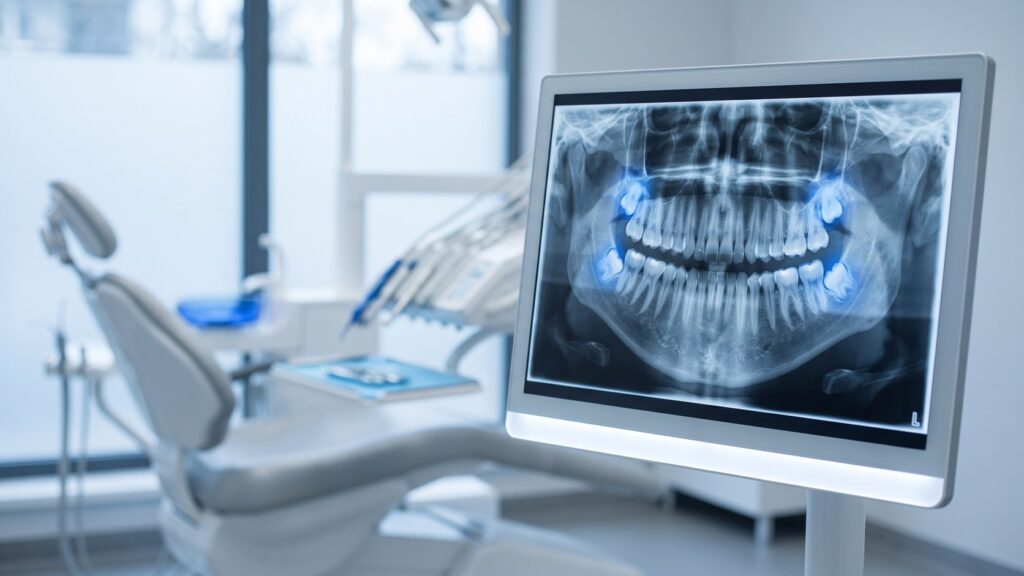
Many people who develop jaw pain around the time their wisdom teeth come in assume the two are connected. It is a reasonable guess, and one of the most common questions patients ask: can wisdom teeth cause TMJ disorders? The honest answer is that the link is weaker than most people think. Here is what the evidence supports, where wisdom teeth genuinely matter, and why pulling them is not a treatment for a jaw joint problem.
QUICK ANSWER
Wisdom teeth are rarely the direct cause of TMJ disorders. Impacted or erupting third molars can produce jaw pain, limited opening, and muscle strain that closely mimics one. The extraction itself, which means holding the mouth wide open, can also aggravate the joint. Most TMJ disorders stem from clenching, joint wear, or bite issues.
What the research says about wisdom teeth and TMJ disorders
The temporomandibular joint, or TMJ, is the hinge that connects your lower jaw to your skull. TMJ disorders are problems with that joint and the chewing muscles around it. Because the joint and the back teeth sit close together, it is natural to assume one drives the other.
Studies have generally not found a consistent link. People who keep their wisdom teeth do not appear to develop TMJ disorders more often than people who have them removed, and removing wisdom teeth has not been shown to prevent or cure them. Related beliefs, such as the idea that wisdom teeth push the other teeth out of line and strain the bite, also rest on weaker evidence than most people assume.
Where wisdom teeth can genuinely contribute
The connection is real in a few narrow situations, and nearly all of them involve the wisdom tooth itself being the problem:
- Impacted or partly erupted third molars. A flap of gum over a partly erupted tooth can become infected and inflamed, causing pain, swelling, and a bad taste at the back of the jaw.
- Muscle guarding. Inflammation near a back tooth can make the nearby chewing muscles tighten, which limits how wide you can open and feels very much like a jaw joint problem.
- Chewing on one side. Protecting a sore area shifts the workload to the other side, and overworked muscles and a strained joint can follow.
In each case, treating the tooth problem usually settles the jaw response. That is also why it looks like a TMJ disorder when it is not one.
Why wisdom tooth pain and TMJ disorders get confused
Both can cause an ache along the jaw, trouble opening wide, and discomfort when chewing. A few patterns help tell them apart.
Signs that point to a wisdom tooth
- Pain centered in the back corner of the mouth.
- A swollen, red, or tender gum behind the last molar, sometimes with a bad taste.
- Pain that is worse when biting on that specific area.
- A tooth that is visible on an X-ray as impacted, tilted, or partly erupted.
Signs that point to the jaw joint
- Pain felt in front of the ear, at the temples, or along the cheek muscles.
- Clicking, popping, or catching when you open and close.
- Soreness that builds with chewing, yawning, or after clenching.
- Morning stiffness or headaches that come with the jaw symptoms.
It is also possible to have both at once, which is why a careful exam matters more than a guess. For a broader look at the condition, see our guide to what TMJ disorders are.
Why jaw pain can flare after wisdom tooth removal
Many people notice jaw soreness after an extraction, even when the jaw felt fine before. The cause is usually the procedure rather than the teeth. Holding the mouth wide open for a long time strains the joint and muscles, and swelling, bruising, and injection sites add to the stiffness. For most people this settles within days to a couple of weeks. If you already clench, grind, or have a clicking joint, the flare can be stronger. Soreness that eases a little each day is usually normal healing. Soreness that is getting worse, or a jaw that stays tight or limited after the first couple of weeks, is worth having examined.
Gentle care usually helps: soft foods, small bites, a warm compress for muscle tightness once the first days of swelling have passed, and avoiding wide yawns and gum. Two situations are worth a call to your oral surgeon: pain that suddenly worsens a few days after the extraction, which can mean a dry socket, and a jaw that will not open or will not close.
If you already have jaw symptoms and an extraction is planned
If you clench, grind, or notice clicking, popping, or locking, tell your oral surgeon before the procedure. Extractions can involve long stretches with the mouth open wide, and a surgeon can plan around a sensitive joint with shorter appointments, breaks to rest the jaw, and careful support during the work.
It also helps to have your jaw evaluated first, so you know your starting point. That makes it much easier to tell afterward whether new soreness is ordinary healing or something that needs attention.
Why extraction is not a treatment for TMJ disorders
Removing healthy wisdom teeth will not relieve a jaw joint problem, because the teeth are not the source. Most TMJ disorders stem from clenching and grinding, muscle overload, joint wear or disc problems, injury, or bite imbalance.
Extraction cannot be undone and carries its own risks. It is the right call when wisdom teeth are impacted, infected, decayed, or damaging neighboring teeth. It should not be done for jaw pain alone.
What an evaluation examines before surgery is discussed
When jaw pain and wisdom teeth overlap, a dentist trained in TMJ disorders will usually work through the question in a set order:
- History and habits. When the pain started, what makes it worse, and whether you clench or grind.
- Muscle and joint exam. Gentle pressure on the chewing muscles and joint while you open and close.
- Range of motion. How far the jaw opens, whether it drifts to one side, and whether it catches.
- Bite and tooth wear. Signs of clenching, uneven contact, or worn surfaces.
- Imaging when needed. X-rays to see the wisdom teeth and, when warranted, the joint itself.
The goal is to decide whether the tooth, the joint, or both need care, and in what order. When the joint is involved, treatment usually begins conservatively, with habit changes, physical therapy, and sometimes a custom oral appliance. Our article on whether mouthguards help with TMJ disorders explains how those devices work.
Frequently Asked Questions
Can wisdom teeth cause jaw pain?
Yes, in some situations. Impacted or erupting wisdom teeth can cause pain and muscle tension that spreads along the jaw. This differs from a TMJ disorder, which starts in the joint and chewing muscles. An exam and X-ray can show which one is responsible.
Does removing wisdom teeth cause TMJ disorders?
Not typically. Jaw soreness after removal is common and usually temporary, caused by holding the mouth open and by swelling. People who already clench or have joint problems are more likely to flare, but extraction is not a proven cause of lasting TMJ disorders.
Will pulling my wisdom teeth cure my TMJ disorder?
No. Wisdom teeth are rarely the source of TMJ disorders, so removal is not a treatment. Extraction is appropriate when the teeth themselves are impacted, infected, or damaging nearby teeth.
Who should I see for jaw pain near my wisdom teeth?
Start with a dentist. An exam and X-rays can show whether a wisdom tooth is involved. If the teeth look healthy or the pain does not match them, a dentist trained in TMJ disorders can evaluate the joint and chewing muscles.