
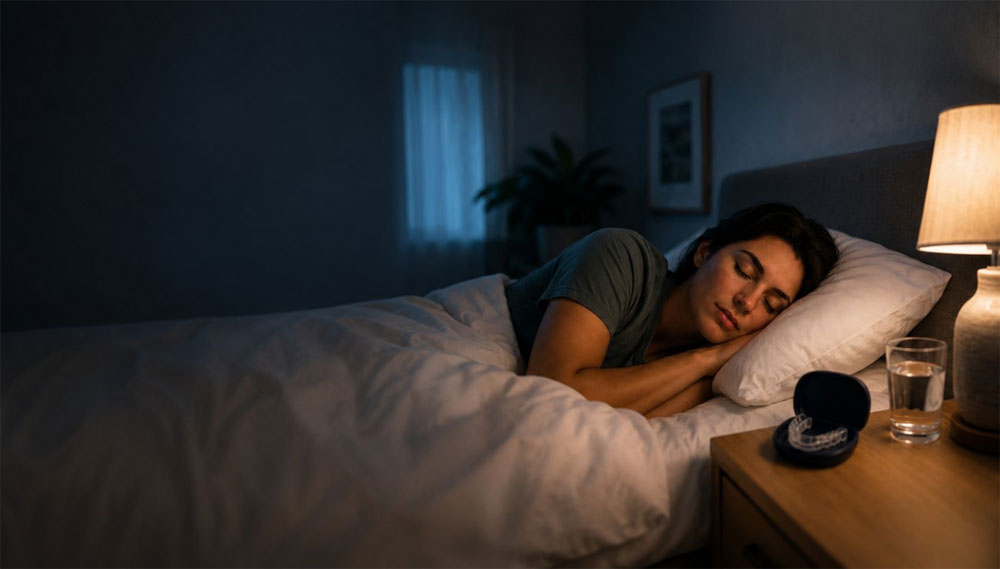
Most people who grind their teeth at night have no idea they do it. They find out the awkward way: a partner hears it, a dentist points to flattened molars, or they wake up with a headache and a sore jaw for the hundredth time. By then, the grinding has often been quietly chipping away at their teeth for years.
The good news is that nighttime grinding, known as bruxism, is treatable once you understand what drives it. This post covers how to tell if you grind, why it happens, the connection to sleep-related breathing disorders that most people miss, and how to stop, starting with what you can do tonight.
How do you stop grinding teeth at night? Teeth grinding at night (bruxism) is usually caused by stress, anxiety, sleep disorders like sleep apnea, or bite misalignment. To stop, many people use a custom nightguard, practice stress reduction before bed, cut back on caffeine and alcohol, and treat any underlying sleep or bite issues. Persistent grinding should be evaluated by a dentist who treats jaw joints.
How to know if you grind your teeth at night
Because it happens while you sleep, you have to read the clues your body leaves behind. The most reliable signs:
- Morning jaw soreness, tightness, or fatigue that eases as the day goes on
- Dull headaches near the temples soon after waking
- Flattened, chipped, or worn teeth, which a dentist often spots first
- Increased tooth sensitivity as enamel thins
- A partner who hears grinding at night
- Indentations on the side of your tongue or a ridged line inside your cheek from clenching
Any two or three of these together make bruxism likely. A dentist can confirm it by reading the wear patterns on your teeth, which tell the story even when you cannot.
Why do you grind your teeth at night?
Bruxism rarely has a single cause. The usual drivers are:
- Stress and anxiety, which can keep the nervous system tense even in sleep
- Sleep disorders, especially sleep apnea, where the body clenches as part of disrupted breathing
- Bite misalignment, where teeth do not meet evenly
- Caffeine, alcohol, and certain medications, which fragment sleep and increase muscle activity
The stress, grinding, and TMJ disorder loop
Here is the trap. Stress increases clenching. Clenching strains the jaw joint and muscles. The resulting jaw pain and poor sleep raise your stress further, which feeds more clenching. It is a loop that reinforces itself, which is why grinding so often shows up during the hardest stretches of life and why “just relax” is useless advice on its own.
This is also how grinding becomes TMJ disorder. Sustained overload on the joint is one of the most common roads into a temporomandibular disorder, which is why bruxism and TMJ disorder so often travel together. If you have started noticing jaw clicking alongside the grinding, that overlap is common and worth raising at an evaluation.
The sleep-related breathing connection most people miss
This is the part that gets overlooked, and it matters. For a meaningful share of grinders, the clenching is not really about stress at all. It is the body’s reaction to interrupted breathing during sleep.
In obstructive sleep apnea, a common sleep-related breathing disorder, the airway narrows or briefly collapses, oxygen dips, and the brain rouses the body to resume breathing. Research has linked these episodes with bursts of jaw-muscle activity, meaning the grinding can be a downstream signal of an airway problem. Treat only the teeth with a guard, and you protect the enamel while leaving the real issue, the disrupted breathing, untouched.
That is why a thorough evaluation asks about snoring, morning fatigue, and daytime sleepiness, not just jaw pain. If those sound familiar, the next step is finding out whether disrupted breathing during sleep is part of the picture.
How to stop grinding teeth naturally, tonight
Start with the levers you control. These genuinely help, especially when stress is the driver:
- Wind down deliberately. A consistent pre-sleep routine and a screen-free buffer lower nighttime muscle tension.
- Cut afternoon caffeine and evening alcohol. Both fragment sleep and increase grinding.
- Try jaw relaxation. During the day, keep teeth apart with the tongue resting on the roof of the mouth; warm compresses before bed loosen tight muscles.
- Manage the stress at the source with exercise, breathing practice, or whatever reliably lowers your baseline tension.
These steps reduce the frequency and force of grinding. What they cannot do is shield your teeth from the grinding that still happens while you sleep, or address an airway problem if one exists.
Why a custom guard beats a drugstore one
A nightguard is the standard tool for protecting teeth from grinding, but the over-the-counter version and the custom one are not the same product. Boil-and-bite guards are bulky, fit poorly, and for some people actually encourage more clenching or shift the bite, which can aggravate the jaw. A poorly fitting guard can trade tooth wear for joint pain.
A custom guard is fitted to your bite, sized to position the jaw correctly, and built to last. More importantly, the dentist fitting one will screen for the things a drugstore cannot: bite issues, early TMJ disorder, and the airway signs of a sleep-related breathing disorder. You are not just buying a piece of plastic, you are getting the cause checked.
The takeaway
Grinding your teeth at night is your body responding to something, usually stress, a misaligned bite, or disrupted breathing. Natural strategies and stress management reduce it, and a custom guard protects your teeth, but the smartest move is to find out what is driving it before you settle for managing the symptom. A guard that hides an airway problem is a missed opportunity.
If you are waking up sore, wearing down your teeth, or have been told you grind, book an evaluation and get the cause identified, not just the damage covered.
Frequently Asked Questions
Can stress cause jaw pain?
Yes. Stress drives clenching and grinding, which overload the jaw muscles and joint, producing soreness, headaches, and over time, TMJ disorder symptoms.
Is a nightguard enough to fix grinding?
A guard protects your teeth but does not address the cause. If stress, bite issues, or a sleep-related breathing disorder are driving the grinding, those need treating too for lasting relief.