
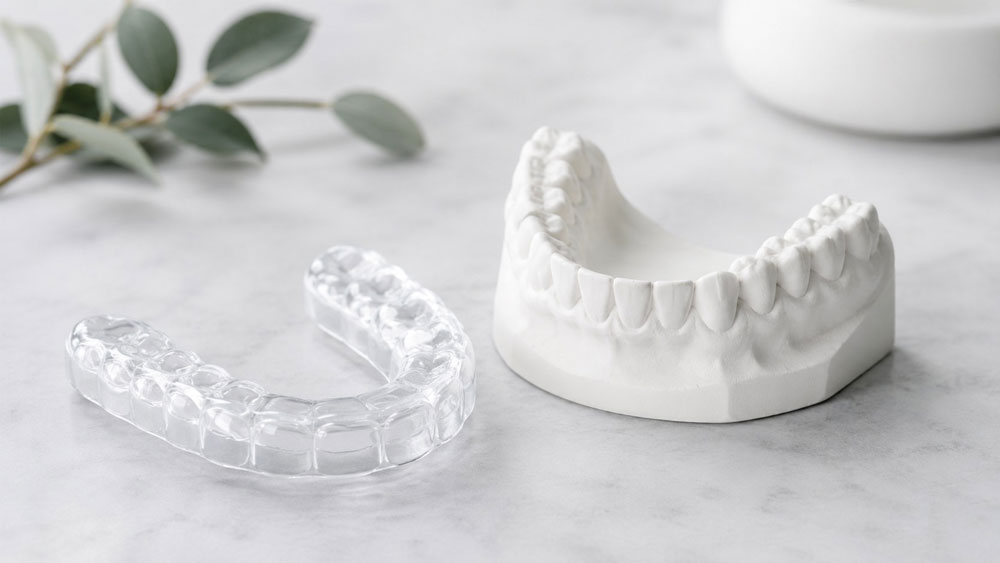
If you have jaw pain, someone has probably told you to just get a mouthguard. It is common advice, and it is half right. So, do mouthguards help with TMJ? Yes, a good one can take real pressure off the joint. But here is what that advice leaves out: the type of guard decides the outcome, and the wrong one can actually make things worse. This is the honest version, what a nightguard does, where the drugstore version falls short, and how to know if a guard alone is enough for your case.
QUICK ANSWER
Yes, mouthguards can help with TMJ disorders by preventing teeth clenching and grinding during sleep, reducing pressure on the temporomandibular joint. However, over-the-counter guards fit poorly and can sometimes make symptoms worse. A custom-fitted oral appliance prescribed by a dentist trained in TMJ disorders provides proper jaw positioning and significantly better results.
How a nightguard actually protects your jaw
Most jaw damage from clenching and grinding happens at night, when you have no idea it is going on. A nightguard sits between your upper and lower teeth and does three things. It cushions the contact so your teeth are not grinding enamel to enamel. It spreads the clenching force across the whole guard instead of concentrating it on a few teeth and one side of the joint. And a well-designed guard subtly discourages the muscles from clamping down as hard in the first place.
The point is not to stop you from clenching by willpower. It is to change what happens when you do, so the force lands on plastic instead of on your joint, your enamel, and the muscles that refer pain into your head the next morning.
Custom vs. over-the-counter: the difference that decides everything
This is where the just get a mouthguard advice goes sideways, because it treats two very different products as the same thing.
A drugstore boil-and-bite guard is a soft, one-size slab you soften in hot water and bite into. It is bulky, it rarely fits the contours of your bite, and because it is soft, some people unconsciously chew on it all night, which can wind the jaw muscles up rather than settle them. It might protect your enamel. It is a poor tool for a joint problem.
A custom oral appliance, the professionally fitted version of a nightguard, is made from a precise scan or impression of your teeth. It fits like a key in a lock, it is built at the right thickness and hardness for your bite, and it is adjusted so your jaw closes into a balanced position. That balance is the part a drugstore guard cannot fake, and it is exactly what an irritated joint needs.
Think of it like footwear for a bad knee. A generic insole is better than nothing, but a fitted orthotic is what actually changes how the joint loads.
Can a mouthguard make TMJ worse? Yes, and here is how
This is the part most articles skip. A guard that shifts your bite the wrong way, sits too thick, or is the wrong type for your problem can increase strain on the joint and leave you waking up more sore, not less. Some over-the-counter guards designed only to protect teeth actually push the lower jaw into a position the joint does not like.
Consider someone who buys a bulky boil-and-bite guard for grinding, wears it for three weeks, and finds their morning jaw pain is worse. They conclude guards do not work for me. In reality, the concept was right and the execution was wrong. A guard is a medical device for your bite, and fit is not a detail. It is the whole thing.
When a nightguard is enough, and when it is not
For jaw pain driven mainly by muscle tension and nighttime clenching, a well-made custom guard is often the single most effective step, sometimes the only one needed. But a mouthguard manages force; it does not repair structure. If your pain comes from a displaced disc inside the joint, arthritis, or a significant bite misalignment, a guard is one piece of a larger plan that may include physical therapy or bite correction. The only way to know which situation you are in is an exam with a dentist trained in TMJ disorders, which is exactly why the drugstore shortcut so often disappoints.
If you are grinding your teeth at night, a custom guard also directly protects you from the cracked teeth and worn enamel that grinding causes over time, a bill that dwarfs the cost of the guard.
The bottom line
Mouthguards help with TMJ disorders when they fit correctly and match your problem. A drugstore guard is a gamble that can backfire; a custom guard is a fitted medical device that takes real load off the joint. If jaw pain, grinding, or morning soreness has you considering a guard, get the exam first so you buy the right one once. Schedule a consultation with Argyle Dental Sleep and TMJ, and find out whether a custom oral appliance is the fix, or the first part of one.
Frequently Asked Questions
How do I stop grinding my teeth at night?
Nighttime grinding is usually tied to stress and clenching, so the most reliable approach combines a custom oral appliance to protect the teeth and joint with stress-reduction habits before bed. Cutting caffeine and alcohol late in the day helps some people, but a fitted guard is what protects your teeth while you address the cause.
How does a mouthguard help TMJ?
It cushions tooth contact, spreads clenching force evenly instead of concentrating it, and helps position the jaw so the joint is not overloaded during sleep, which reduces morning pain and prevents damage.





1 Comment. Leave new
[…] Custom nightguards. A properly fitted oral appliance keeps the jaw in a more neutral position overnight and reduces the muscle strain from clenching. Unlike an over-the-counter option, a custom guard is molded to your bite, which means it stays in place and distributes pressure evenly rather than concentrating it on a few teeth. See whether a mouthguard could help your case. […]