
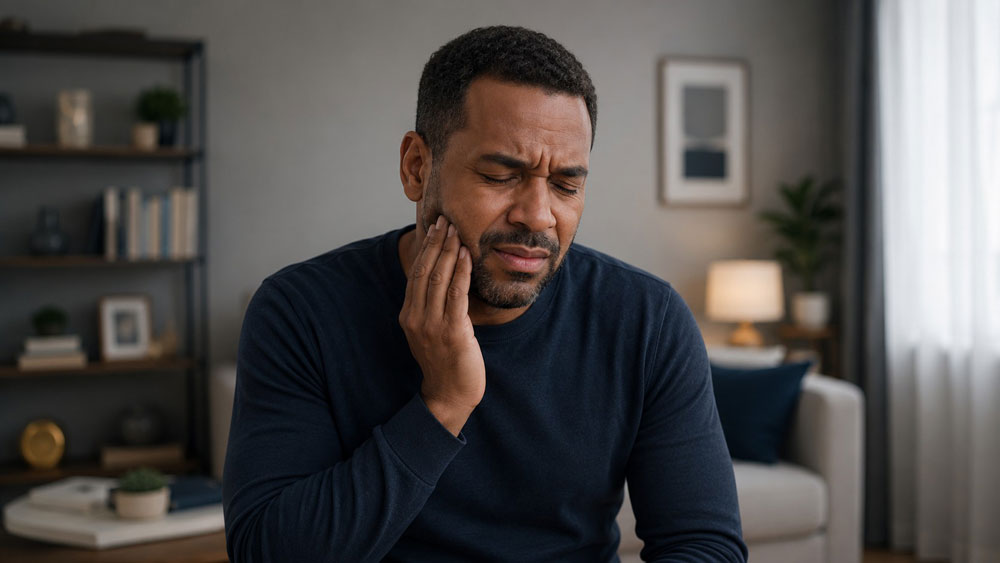
Good news: several of the most effective at-home methods take minutes and use things you already own. Below are seven that actually work, in the order most people find easiest to start. At the end, one honest note about why relief now is not the same as a fix, so you know when it is time to get seen.
QUICK ANSWER
To relieve jaw pain immediately: apply a warm or cold compress to the jaw for 15 to 20 minutes, take an over-the-counter anti-inflammatory, eat only soft foods, avoid wide mouth movements, gently massage the jaw muscles, practice slow deep breathing to reduce clenching, and rest your jaw by keeping teeth slightly apart.
7 ways to calm jaw pain right now
- Apply a compress for 15 to 20 minutes. Heat relaxes tight muscles; cold numbs sharp pain and reduces swelling. Wrap either in a thin towel and hold it against the sore side.
- Switch to soft foods. Yogurt, eggs, soup, and pasta let the joint rest. Every bite of a bagel or steak is a rep the joint does not need right now.
- Rest the jaw in the right position. Lips together, teeth slightly apart, tongue resting on the roof of your mouth. More on this below, because most people get it wrong.
- Massage the muscles gently. Use two fingers on the cheek muscle just below your cheekbone and the temple. Small circles for a minute or two release the knots that refer pain into your head and ear.
- Take an over-the-counter anti-inflammatory. Something like ibuprofen calms inflammation in the joint rather than only dulling pain. Follow the label and check with a pharmacist if you have any reason to.
- Slow your breathing to unclench. Jaw pain and stress feed each other. Four counts in, six counts out, for two minutes, and let your jaw go slack as you exhale.
- Avoid wide mouth movements. Stifle big yawns with a hand under the chin, and skip singing along in the car until the flare passes.
Heat or cold: which one, and when
Reach for cold when the pain is sharp, recent, or the area feels swollen, such as after a long dental appointment or a hard chew. Cold slows the inflammation. Reach for heat when the muscles feel tight and achy, which is the more common jaw complaint, especially in the morning. Heat loosens the clenched muscle so it stops pulling on the joint. If you are not sure, start with heat for muscle tightness. Twenty minutes is the ceiling for either; longer does not help and can irritate the skin.
The resting jaw position almost nobody uses
Here is the one most people get wrong. Your teeth are meant to touch only when you eat, which adds up to a few minutes a day. The rest of the time, your resting position should be lips together, teeth slightly apart, tongue lightly on the roof of your mouth behind your front teeth. Picture the little gap you leave when you say the letter n and hold it.
Try it now and notice how your jaw drops and softens. If your teeth were touching a moment ago, you just found a habit that quietly loads the joint all day. Catching yourself and resetting to this position is one of the highest-value things you can do, and it costs nothing.
What not to do when your jaw flares
- Chewing gum or hard, chewy foods. This is the fastest way to turn a two-day flare into a two-week one.
- Wide yawns and big bites. Overextending the joint mid-flare can lock or aggravate it.
- Cradling your phone against your shoulder. It jams the neck and jaw together for the whole call. Use earbuds.
- Grinding through it at your desk. Stress clenching is often what started the flare. A sticky note on your monitor that just says teeth apart works better than willpower.
When jaw pain means you should be seen today
Most jaw pain is muscular and settles with the steps above. Get help promptly if your jaw locks open or shut, if you suddenly cannot open or close it normally, if there is significant swelling, if pain comes with a fever, or if it followed a blow or injury. These point to something the home methods will not resolve, and waiting can make treatment harder.
Relief now, and a real fix next
Here is the honest part. Everything above calms a flare, but if your jaw keeps flaring, something is driving it, usually nighttime clenching, a bite issue, or joint irritation that will not settle on its own. Compresses and soft food do not change that any more than aspirin changes why you keep getting headaches.
If this is your second or third flare, or it never fully clears, that is the signal to move from managing pain to solving it. Book a visit with a dentist trained in TMJ disorders at Argyle Dental Sleep and TMJ. They can pinpoint what is triggering the pain and build a plan so you are not back here searching for relief again next month.
Frequently Asked Questions
How do I relieve jaw and ear pain together?
The jaw joint sits right in front of the ear canal, so joint irritation often refers pain into the ear even when the ear is healthy. The same steps help both: heat or cold on the joint, soft foods, gentle massage, and resting the jaw. If ear pain comes with fever, discharge, or hearing changes, have the ear itself checked.
What should I do if jaw pain will not go away?
Persistent jaw pain, more than a week or two, or pain that keeps returning, is not something to keep self-treating. It usually has an underlying cause that needs a proper exam to identify and address.