
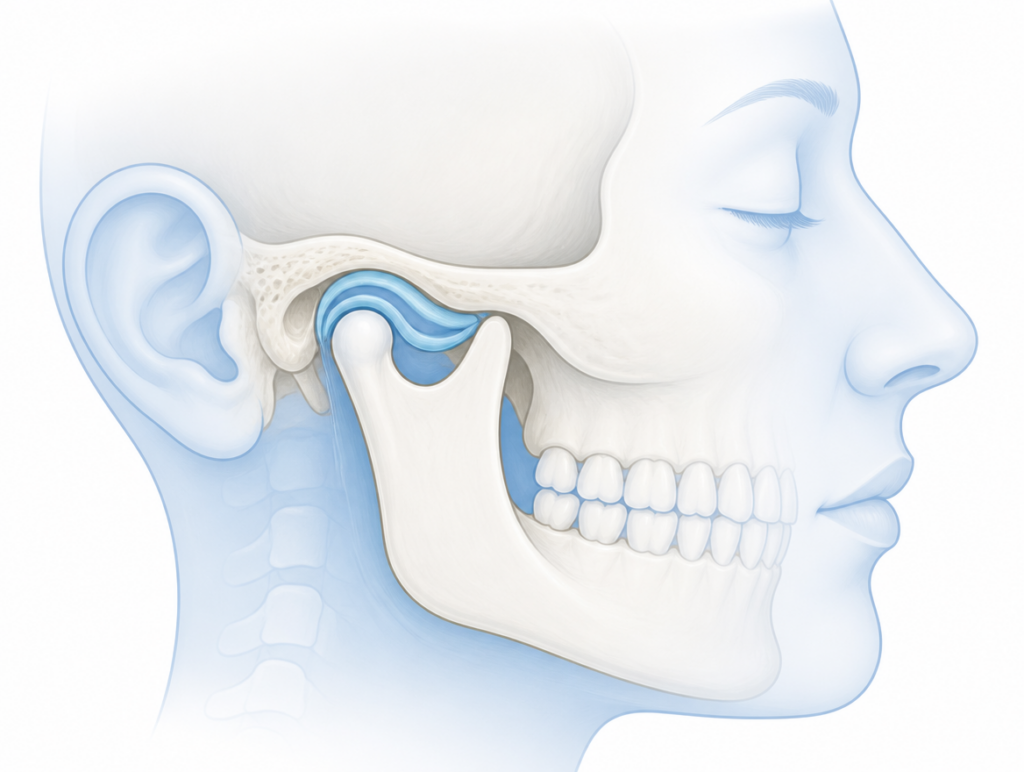
Sometimes TMJ disorders involve the joint itself rather than just the surrounding muscles, most often when the small disc inside the joint becomes stuck, or “non-reducing,” and prevents the jaw from moving smoothly. A joint injection is an in-office procedure designed to address exactly this problem.
During the procedure, Dr. Argyle will use a local anesthetic and gently inject into the joint in order to fill the joint space with fluid that will allow increased pressure inside of the joint ultimately allowing the articulating disc to come back into position. We then immediately fit you with a temporary orthotic that will help position your jaw in a way that will maintain proper positioning of the disc. This temporary orthotic will need to be worn 24 hours a day for several days in order to stabilize the disc and prevent it from slipping back out of place and locking up on you again.
Joint injections are typically considered when more conservative options, like an orthotic or physical therapy, haven’t fully resolved a locking or catching sensation in the jaw. The procedure itself only takes several minutes, and most patients go home the same day with some temporary soreness that resolves within a few days.
Dr. Argyle will confirm through examination whether your symptoms point to a joint-level problem before recommending this treatment, since locking and catching can have several different causes.

Talk to Dr. Argyle About Joint Injections in Syracuse, UT
If your jaw is locking or catching and conservative treatment hasn’t resolved it, a joint injection may be the next step. Our office is at 780 S. 2000 W., Suite E-301 in Syracuse, UT 84075, serving patients from North Salt Lake through Davis, Weber, Box Elder and Cache Counties, as well as southern Idaho and southwest Wyoming. Call (801) 774-7520.
Frequently Asked Questions
What happens during a TMJ disorder joint injection?
Dr. Argyle numbs the area with a local anesthetic and gently injects fluid into the joint space. The added pressure allows the displaced disc to move back into position, and you are then fitted with a temporary orthotic to wear 24 hours a day for several days while the disc stabilizes.
How long does a TMJ disorder joint injection take?
The procedure itself only takes several minutes, and most patients go home the same day.
What is a TMJ disorder joint injection used for?
It’s most often used when the disc inside the jaw joint becomes stuck and causes locking or catching that hasn’t responded to more conservative treatments like an orthotic or physical therapy.