If you have been diagnosed with obstructive sleep apnea, an oral appliance may be the treatment that finally works for you. At Argyle Dental Sleep and TMJ, Dr. Jaren Argyle designs small, custom-crafted oral appliances that gently shift your lower jaw forward, keeping your airway open while you sleep. There is no mask, no hose and no machine noise.
Oral appliance therapy is a comfortable, effective option for many patients, and it is the treatment Dr. Argyle has built his practice around. Patients travel to our Syracuse office from across Davis and Weber Counties (Layton, Clinton, Clearfield, Kaysville, West Point, Roy, West Haven and South Weber) to be fitted for one.
How an Oral Appliance Treats Sleep Apnea
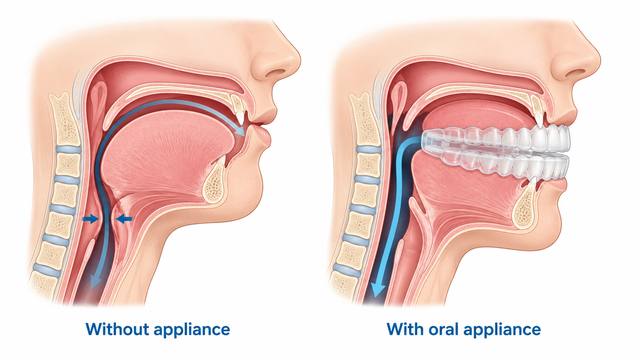
Obstructive sleep apnea happens when the soft tissues at the back of your throat relax during sleep and collapse into your airway, interrupting your breathing over and over through the night. An oral appliance, clinically called a mandibular advancement device, holds your lower jaw in a slightly forward position, which pulls the base of the tongue and surrounding tissue away from the back of the throat and keeps that airway open.
The appliance looks and feels much like a mouthguard, and it is custom-fitted to your unique bite rather than boiled and molded at home. That fit is what makes the difference between a device you wear every night and one that ends up in a drawer.
The Types of Oral Appliances We Fit
There is no single best oral appliance. Dr. Argyle fits four different designs, and which one is right for you depends on which teeth you have and the contours of them. That assessment is part of your exam, and it is a large part of why a custom appliance outperforms anything bought over the counter.
| Appliance | How it holds the jaw forward |
|---|---|
| EMA | Interchangeable elastic straps connect the upper and lower trays. Swapping strap lengths adjusts how far the jaw is advanced. |
| Herbst | Telescopic metal arms on each side connect the upper and lower trays and set the advancement mechanically. |
| Dorsal | Angled guides on the upper tray meet fins on the lower tray, positioning the jaw as you close. |
| TAP | A single adjustable hook and screw at the front of the mouth, which you or Dr. Argyle can fine-tune. |
All four are mandibular advancement devices, and all four work on the same principle: holding the lower jaw slightly forward so the airway stays open. The differences come down to how they hold that position, how they are adjusted, and which one fits your dentition best.
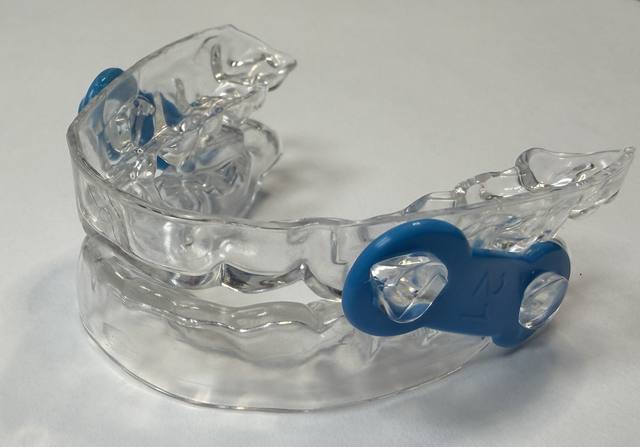
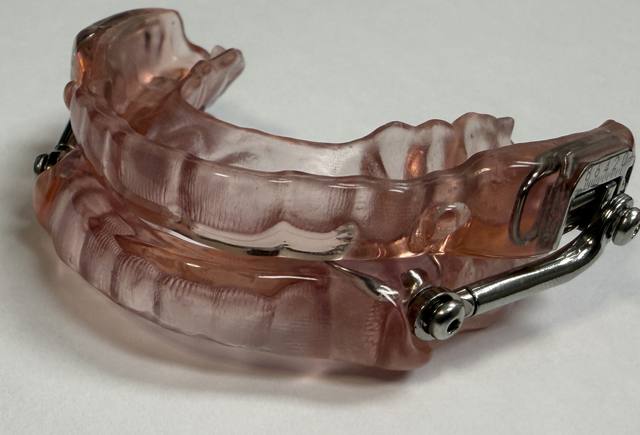
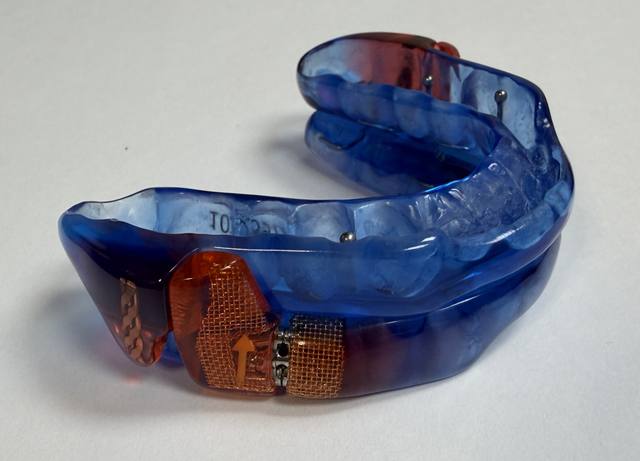
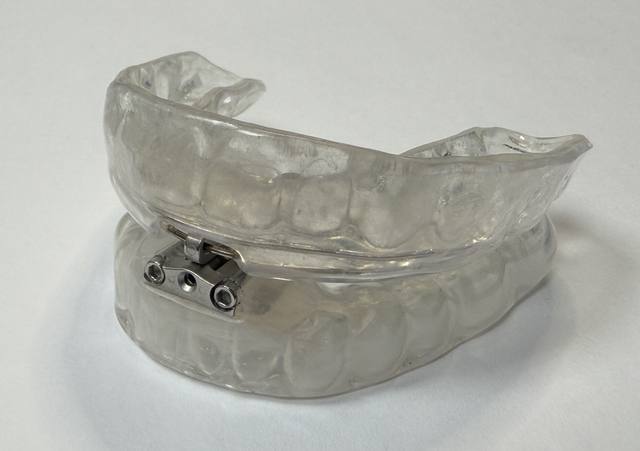
These are appliances from our own office, not stock images. Dr. Argyle will show you the options and explain which one suits your dentition at your exam.
Why Patients Choose Oral Appliance Therapy Over CPAP
Oral appliance therapy is an effective, non-invasive treatment that fits easily into your lifestyle. Patients tell us they prefer it because it is:
- Comfortable, with no mask pressing against your face
- Easy to wear, in your mouth and you are done
- Quiet, with no motor and no airflow noise for you or your bed partner
- Portable enough to fit in a pocket
- Travel-friendly, with no power supply, no distilled water and no TSA conversation
- Easy to care for, brushed and rinsed like a retainer
If you are weighing your options more broadly, our sleep apnea treatments overview compares oral appliance therapy against PAP therapy, myofunctional therapy and surgery.
Is an Oral Appliance Right for You?
Oral appliance therapy is a recognized treatment for obstructive sleep apnea. It is most often prescribed for mild to moderate cases, and for patients with severe sleep apnea who cannot tolerate CPAP. It is also an effective option for primary snoring without apnea, and for patients with upper airway resistance syndrome.
You will need a diagnosis from a physician before treatment begins. A dentist can screen you for the signs of sleep apnea and refer you for a sleep study, but the diagnosis itself comes from a sleep physician reviewing your test results. Dr. Argyle works closely with the local sleep physicians throughout Davis and Weber Counties, so if you have not been tested yet, we can help you get that started.
What to Expect, Visit by Visit
Treatment follows a defined sequence, and it starts before you ever come into the office.
| Step | What happens |
|---|---|
| Initial phone call | A short conversation about your symptoms, your diagnosis if you have one, and how the process works. |
| Telemedicine consultation | A video visit with Dr. Argyle to review your sleep study and discuss whether an oral appliance is a fit for you. No travel required. |
| Oximetry baseline | An at-home overnight test that records where you are starting, so your results can be measured against it later. |
| Exam and CBCT | An in-office examination of your teeth, jaw, tongue and airway, with a 3D cone beam scan to assess your jaw structure, joints and teeth. |
| Records appointment | Impressions and scans of your teeth so the appliance can be fabricated. Often combined with the exam appointment. |
| Delivery appointment | You receive your appliance. Dr. Argyle fits and adjusts it, and shows you how to clean and care for it. |
| Follow-up appointments | Scheduled as needed to fine-tune the fit and gradually adjust how far the jaw is advanced. |
| Follow-up oximetry | A second overnight test, compared against your baseline, to confirm the appliance is actually working. |
| Annual follow-up | A yearly check of the appliance, your teeth and your results. |
That second oximetry test is the step most offices skip. Fitting an appliance and assuming it worked is not the same as measuring whether it did, and it is the difference between treated sleep apnea and a device you wear every night for nothing.
Why Choose Dr. Argyle

Dr. Argyle is a Diplomate of the American Board of Dental Sleep Medicine, the field’s board certification. He is also a member of the American Academy of Dental Sleep Medicine, the American Dental Association and the Utah Dental Association. He works closely with sleep physicians throughout northern Utah, including Dr. Gary J. Alexander, Dr. Suleman Iqbal and Dr. Richard Hammond, in treating snoring and obstructive sleep apnea. Dental sleep medicine is not a sideline of a general practice here. It is the focus of the practice, alongside TMJ disorder treatment.
That matters more than it might sound. Oral appliance therapy succeeds or fails on the follow-up: the fit adjustments, the titration, and the verification testing that most offices skip. Meet Dr. Argyle and the team.
Cost of Treatment
You should know what treatment costs before you commit to it. Dr. Argyle reviews the full cost of therapy with you at your first visit, before any treatment begins, along with how many visits to expect and what is included. Nothing gets started until you have that picture and your questions are answered. See our financing options if you would like to spread the cost out.
Serving Syracuse and Northern Utah
Our office is at 780 S. 2000 W., Suite E-301 in Syracuse, UT 84075, convenient to Layton, Clinton, Clearfield, West Point, Kaysville, Roy, West Haven and South Weber.
Call (801) 774-7520 or request a consultation and let us find out whether an oral appliance is the right fit for you.
Frequently Asked Questions
Do you make the oral appliances here?
Yes. Dr. Argyle takes your records in our Syracuse office and the appliance is custom-fabricated to your bite at a dental laboratory, then fitted and adjusted here. It is made for your dentition specifically, which is what separates it from a boil-and-bite mouthguard bought over the counter.
How much does oral appliance therapy cost?
Cost depends on which appliance is right for you and how many follow-up visits your treatment requires. Dr. Argyle reviews the full cost with you before any treatment begins, so you know what to expect before committing to anything. Financing options are available. Call (801) 774-7520 and our team can walk you through it.
How long does the whole process take?
It varies, but the sequence is defined: a phone call, a telemedicine consultation, an at-home oximetry baseline, an exam with a CBCT scan, a records appointment, then delivery of your appliance. Follow-up visits fine-tune the fit afterward, and a second oximetry test confirms the appliance is working before you are done.
How soon can I get scheduled?
Usually sooner than patients expect, since the first two steps are a phone call and a telemedicine visit rather than an in-office appointment. Call our Syracuse office at (801) 774-7520 and we can tell you current availability and get the process started, often before you have taken your baseline sleep test.
Is an oral appliance comfortable to wear?
Most patients adjust within one to two weeks. The appliance is custom-fitted rather than one-size-fits-all, and it is advanced gradually rather than set to its final position on day one, which makes the adjustment considerably easier. Follow-up visits exist specifically to fine-tune comfort until you are wearing it every night without thinking about it.
Can I still move my mouth with the appliance in?
Yes. The appliance holds your lower jaw in a slightly forward position, but you can still open and close your mouth, swallow and speak. Some designs allow more side-to-side movement than others, which is one of the factors Dr. Argyle weighs when choosing which appliance suits you.
How does the appliance hold my jaw in position?
It depends on the design. EMA appliances use interchangeable elastic straps, Herbst appliances use telescopic metal arms, Dorsal appliances use angled guides that meet as you close, and TAP appliances use an adjustable hook and screw at the front. All four hold the lower jaw forward so the airway stays open.